
Lake District Mountain Guides
How to Find the Cioch Nose, Applecross: A Complete Guide to Scotland’s Best Climb
I climbed the Cioch Nose recently and I’ll be honest — finding the start was the hardest part of the whole day. For a four-star classic rated as one of the finest climbs in Scotland, it is frustratingly poorly signposted, and plenty of parties arrive at the crag and spend an embarrassing amount of time wandering around on the Middle Ledge wondering what on earth is going on.
This guide covers everything you need to know: where to park, how to approach, and — most importantly — exactly how to find the start of the route.
July 8, 2026
Lake District climbing
What is the Cioch Nose?
The Cioch Nose takes a superb line up the nose of A’ Cioch on the north face of Sgurr a’ Chaorachain in the Applecross Peninsula of the Scottish Highlands. It was first climbed by Tom Patey and Chris Bonington in August 1960 and has been a sought-after tick ever since.
The numbers:
- Grade: Hard Very Difficult (HVD), 4a
- Length: 200m, 7 pitches
- Stars: ★★★★ (4 stars — one of only a handful of climbs to achieve this in all of Scotland)
- Descent: South Gully abseil or continuation traverse of A’ Cioch Ridge
- Getting there: Park at the Bealach na Bà viewpoint at the summit of the Applecross pass. There is a large car park here with an orientation indicator and stunning views over to Skye and the Cuillin on a clear day. Grid reference: NG 7785 4223.
Despite the grade, this is not a pushover. Several users on UKClimbing rate pitch 2 as Severe/HS in character, and the route feels sustained throughout. The walk-in in wet conditions is also not to be underestimated — the path is steep and slippery.
The Approach — Step by Step
This is where most people go wrong. The approach is not obvious, and the path is not well-worn in places. Follow these steps carefully.
- Approximate approach time: 45–60 minutes from the car park.
- Head for the communications mast: From the car park, head towards the obvious mast on the skyline. This is on or near the summit of Sgurr a’ Chaorachain.
- Turn east just before the summit: Just short of the summit, leave the main path and head east, taking the steep path down into Coire a’ Chaorachain. This is the corrie below the north face. The descent is steep and can be very slippery in the wet.
- Follow the burn, past the pond :Once in the corrie, follow the burn on your right. You will pass a small pond. Continue on flatter ground beyond it.
- Look for the roofs in the wall :As you continue, the cliff face to your left will begin to show a series of low roofs. These are your key landmark. Keep walking along the base of the crag.
- Find the path diverting left — before the ground drops away: Before the ground starts to descend again, you will see the path divert left and upward towards the base of the wall. This is where the two starts are located. Do not walk past this point and continue downhill.
Finding the Exact Start — The Bit I got Wrong
Here’s what catches people out:
Middle Ledge is actually two ledges, around 5 metres apart vertically — a lower one and an upper one. You need to be on the upper ledge to find the actual start. If you’re on the lower ledge and can’t find anything obvious, scramble up 5 metres to the upper tier.
There is also a boulder that can block your path along Middle Ledge. If you hit it, don’t try to go over it — backtrack slightly and look for a path a couple of metres below that loops around it and brings you back up to the start.
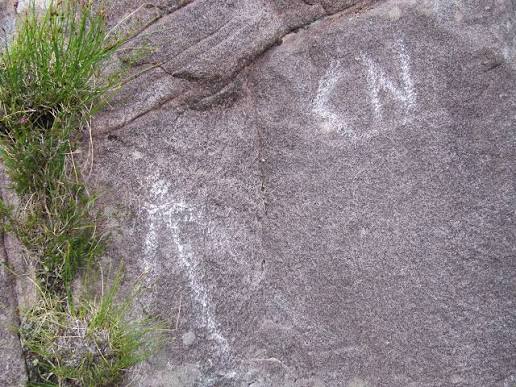
The key marker: Look for the letters “CN” scratched into the rock, with an arrow pointing to the start. It is very faint, so look carefully. There is also a flake-crack above a small step up in the path — this is the beginning of Pitch 1.
Uk Mountain guiding
Route Description
Pitch 1 — 30m, 4a
Above the step-up in the path is a flake-crack. Gain and climb this to a ledge. Move left, up over a block, and climb consecutive tricky corners to reach the Upper Ledge. Belay here, then transfer 5 metres right to below a short V-chimney with an undercut base.
Pitch 2 — 15m, 4a
Climb the chimney and exit on the right, then up and right over clean rock to a belay ledge. This is widely described as the best ledge in Scotland — a broad, flat platform with exceptional views. Note: some parties rate this pitch closer to Severe than the guidebook suggests.
Pitch 3 — 35m, 4a
Step right onto exposed ground, then traverse diagonally right for 5 metres on excellent holds (past a peg runner). Climb up and left to a ledge below a small overhang. Pass the overhang on the left and return right immediately above it to a large ledge.
Pitch 4 — 45m
Walk 10 metres right along the ledge and belay. Climb onto a big block, move up, then step right around the arête and take the natural left-trending line of grooves and flakes to the top of A’ Cioch.
Pitches 5–7 — The Continuation Ridge
From the top of A’ Cioch, the route continues along the spectacular ridge. This involves scrambling over and around several false summits, a further roped pitch on a slab, and a section of enjoyable exposed ridge to the true summit. Allow an extra 2 hours for the full continuation.
The ridge return brings you back to the mast and the car park — making this a superb round trip.
Practical Information
Rack: A light rack with a sectioins of large - med wires, Dmm dragon cams medium sizes, 1x 240 sling and 2x 120 slings as well personal climbing equipment
Rope: we carried 50 meter 8.5 halfs but you could get away with a single in my opinion
Conditions: The route faces north and can hold moisture. It is best on a dry day after a spell of settled weather. The walk-in path is genuinely slippy when wet.
Time: Allow 3 hours for the climb itself. If doing the full ridge continuation, add 2 hours. Total day from the car park: 6–7 hours.
Navigation notes: The summit mast on Sgurr a’ Chaorachain is very useful in poor visibility and serves as a landmark for both the outward walk and the return.
If you’re new to multi-pitch climbing, or you’d like to build the skills and confidence to tackle routes like this independently, North West Mountain Guides offer rock climbing courses in the Lake District and private mountain guiding that can help you get to that level. We also run scrambling courses in the Lake District that are great preparation for longer ridge days like the A’ Cioch continuation.
In a Nut Shell
- Park at the Bealach na Bà viewpoint (NG 7785 4223)
- Head for the mast, then turn east and descend into Coire a’ Chaorachain
- Follow the burn past the pond, continue on flat ground
- Watch for the roofs in the wall to your left
- Turn left and up before the ground drops away again
- Look for “CN” scratched on the rock — it’s faint but it’s there
- Make sure you’re on the upper tier of Middle Ledge, not the lower one
- Enjoy one of the best climbs in Scotland
Have you climbed the Cioch Nose? If you have any updated beta on conditions or the approach, leave a comment below — we’ll keep this guide updated.
FAQs
Cioch Nose FAQs
Hard Very Difficult (HVD), 4a — but most parties agree it climbs more like a Severe, particularly Pitch 2. Treat it as a solid Severe when deciding if it’s for you.
Allow around 3 hours for the climb, plus a 45–60 minute walk-in from the Bealach na Bà car park. With the ridge continuation, expect 6–7 hours car to car.
Tom Patey and Chris Bonington in August 1960. Patey famously described it as “the Diff to end all Diffs”.
A light trad rack with a few long slings and a single 60m rope. No large cams needed.